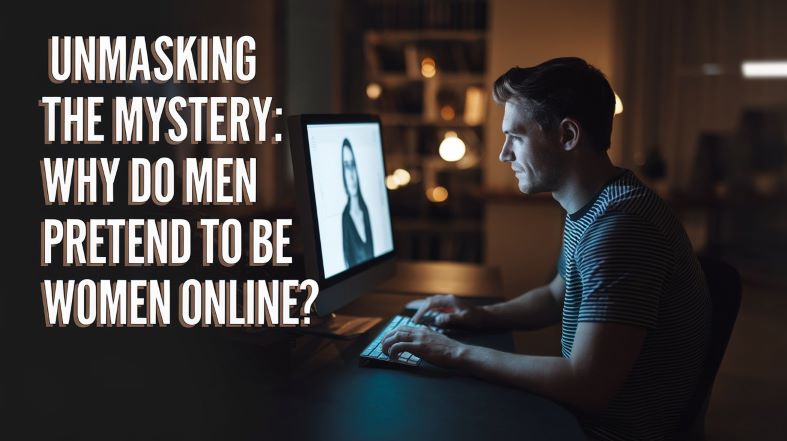

Are you confused about why men would pretend to be women online? This phenomenon has plagued the internet for many years, and it is finally time to unmask the mystery behind it, in this article, we also have another article about catfishing people online here.
While the motivations behind it may vary case by case, a certain consensus has been established regarding why some guys will go to the lengths of masquerading as women online. Whether this online deception is on designated platforms specifically designed for this purpose, or simply in everyday conversations, there is a need for understanding the motives behind such behaviour.
In this blog post, we will dive deep into why men pretend to be women online, discuss the implications of this phenomenon, and provide some tips on how to recognise when online behaviour may not be quite on the level. So if you want to know the answer to the age-old question – why do men pretend to be women online? – then buckle up, because you are about to find out.

There have been men pretending to be gals for years. For example, in drag, where guys do their makeup and wear outrageous dresses, wigs and heels, but this is not quite the same as it’s clear they are not trying to trick people as people are doing online.
One of my past experiences
I was in a chat room once and was in conversation with a sexy woman who gave me their phone number. Now I am pretty well versed that anyone who just gives up their phone number straight away is fake, but I added them as I am not scared of adding people, and back then there was a feature on Instagram.
When you add a contact on your phone, when you go onto Instagram, it shows you who has a profile on Instagram that is also a contact on your phone, as it’s tied to your phone number. Now there was a guy there.
He had to be the fake person I just added to my contacts. It was clearly a gay guy. He had all the flags in his image, but the thing that really annoyed me about it was he had stand-up-to-bullying flags, and stand-up for gay rights in all his images, and yet he went onto a chat site pretending to be a woman and catfished me. I told him I know you are a guy and he just said “F*** O** and blocked me.
I believe this kind of thing is happening a lot, and the main reason people do it is because they can. The fact of the matter is it is not something the police can help you with, they are busy enough, but these kinds of encounters are happening all over the internet to men women and children and we need to do something about it.
Quick Response
In some cases, men may pretend to be a woman online in order to receive better treatment or access to things they may not otherwise have. It could also be an attempt to get attention or validation from people who may respond positively to someone of the opposite gender.
There is also a more disturbing part of this deception, where people fulfil their selfish sexual gratification by pretending to be female or male to get adult-rated pictures from other straight men, or women, pretending to be the opposite sex allows them to gather images and videos of the unsuspecting user, while pretending to be someone else and sending the user fake images, catfishing the user, this is a pretty sick thing to do and sadly very common, hopefully, a crackdown in the law will outlaw catfishing in time, making it a criminal offence.
If someone has done this to you and has posted your images or videos online, this is a CRIMINAL offence, you can speak to the police on 101 and report this as a crime. You should not feel ashamed in any way. It’s normal for adults to share adult equipment with each other. However, you have been tricked.
What Is “Pretending to be a Woman Online”?
Pretending to be a woman online is when a man chooses female avatars and alter-egos, and then assumes the persona of that made-up online character in various online spaces. It can manifest as an act of escapism into different worlds, or as an attempt to explore alternate gender identities. Yet on the other hand, it can also be a form of deception meant to manipulate, conceal identities, and engage in non-consensual behaviour. Many people find this objectionable and have proclaimed that pretending to be a woman online is unethical and should not be allowed.

On one side of the debate are those who see no harm in going undercover by assuming a female or non-binary identity online. They argue that there is nothing wrong with role-playing as long as it does not involve any illegal or malicious activities. For example, some men may use a female avatar for gaming or to go incognito on social media networks without hurting anyone. In addition, those who advocate creating alternate avatars often point out that it allows people to express aspects of themselves they might not feel comfortable sharing publicly under their real identities.
On the other hand, there is growing concern over how pretending to be someone else damages trust in online communities, contributes to privacy violations, and undermines gender equality. For instance, if a man pretends to be a woman in order to take advantage of someone else’s vulnerability or access resources meant only for women, such acts are not only considered deceptive but morally wrong. In addition, some critics say that pretending to be a woman online can increase hostility towards women by normalising male behaviour that is degrading and offensive towards women.
Given these two perspectives, it is clear that exploring the motivations behind why men pretend to be women online requires further examination. Such research will help us gain deeper insights into this controversial phenomenon and inform us about potential strategies for addressing it more effectively. To better understand why this occurs, our next section will focus on the main reasons why men choose to pretend to be women online.
- A 2016 study found that 7% of the sample studied (750 participants) had pretended to someone they were female when communicating online.
- An additional study conducted in 2017 revealed that 8.6% of male respondents had pretended to be a woman at least once for social reasons.
- Another survey conducted in 2018 showed that 15% of male participants had lied about their identity online by pretending to be a female.
The numbers will be even higher now,
Reasons Why Men Pretend to Be Women Online
When exploring the mysteries behind why men often pretend to be women online, there are several explanations that can be found. Men may choose to pose as a woman in order to explore a different gender identity, experience what it might be like to be a female in an online environment, or perhaps express themselves more freely. While there is much debate about why exactly men choose to adopt female avatars, the reasons discussed below may provide an explanation for this behaviour.
First, many men who pose as females online claim that they enjoy the attention and freedom associated with being viewed as female. Males can reap the benefits of being considered attractive or physically appealing when they inhabit a female persona — something many find difficult to do in their everyday lives. Van Olphen, published in The Huffington Post, highlights this when they explain how men turn to female avatars as an “escape hatch” from their reality in order to gain male attention and affirmation through compliments on their looks or personality.
Others suggest that some men may be seeking an escape from their gender roles and expectations by assuming another identity entirely. It has been noted by researchers such as Elizabeth Behm-Morawitz that males taking on a female persona have more freedom both in terms of expressing emotions and engaging in activities generally deemed feminine than when participating under their own identities as males. This suggests that for at least some men, inhabiting a false female persona online can alleviate male social pressures or stereotypes and allow them to engage in activities solely for enjoyment or amusement – all without being judged by their real-world peers who may be unaware of their online activity.
Although there is no definitive answer as to why men pretend to be women online, this phenomenon appears quite common among certain populations on the internet. Understanding and debating both sides of the argument can help us unpack why and how such behaviours arise – even if we never reach a much-desired resolution on the matter.
Leading into the sense of security and anonymity that comes with making use of an altered identity online is the next important step towards understanding this strange but fascinating phenomenon. We will now turn our attention towards exploring how adopting false identities plays into providing users with a sense of security and anonymity while they engage online.
Sense of Security and Anonymity
When it comes to understanding why men often pretend to be women online, one of the key aspects is a sense of security and anonymity. By assuming a different identity or gender, men can feel more secure knowing their real identity remains unknown from potential harm. Beyond this protective function, being anonymous online allows men to explore and interact within a community in which there is no fear of judgement or criticism.
The opposing argument notes that not all anonymity offers this degree of protection. Anonymity can also facilitate criminal activities such as cyberbullying, trolling, catfishing, and other forms of harassment. As such, it is important to keep in mind the motivations behind masked identities when considering how they should be managed and controlled.
These considerations are particularly important with regard to the idea of security and anonymity online, as there can be both positive and negative consequences associated with its use. Ultimately, exploring the range of possibilities in this regard can help us to better understand why men choose to adopt female personas in the digital space.
Having considered the sense of security and anonymity that masks can offer men in an online environment, we now turn our attention to exploring how these dynamics translate into a desire for men to take part in specific gender behaviours when adopting female identities.
To Take Part in Gender Behaviours
Given the anonymous environment that the online world offers, men may take on different gender behaviours to explore and experience something out of the ordinary. This can range from flirting as a woman to making money or simply being curious about exploring virtual personas that are different from their own. In addition, some men may utilise female identities as a way to evade traditional ideas of masculinity. These men may feel pressure to be strong and emotionally detached, which can lead them to seek alternative scenarios where they can be more vulnerable and expressive.
On the other hand, men who do not partake in gender-bending behaviour can also benefit due to the online platform’s ability to provide new outlets for self-expression. For instance, many gay men who are not able to express themselves freely offline use the Internet as an escape route and a safe space to interact with others. Additionally, some men see this behaviour as an opportunity to express homosexual tendencies or alternate gender roles that have been confined by traditional male roles.
Regardless of why someone engages in these activities, it is clear that online communities provide a loophole where people can explore various aspects of identity and behaviour without having to step outside of their comfort zone—which may be viewed as liberating for some and threatening for others. By taking part in gender behaviours, individuals are able to challenge conventional norms and discover unknown possibilities tucked away within each identity. Therefore, it is important for those engaging in gender behaviours online to consider their actions carefully so as not to damage any existing relationships or deceive anyone involuntarily.
Still, it should also not be overlooked that embracing gender roles doesn’t necessarily mean an individual is engaging in deception; if done ahead of time with full transparency and consent from both parties involved, then no harm has been done. With this in mind, we now turn our focus onto one form of online deception: types of online deception.
Types of Online Deception
Online deception has been around for decades and is as varied as the motivations behind it. Some people online use false identities and/or pictures to hide their true identity, while others may rewrite history and present a version of themselves that’s different from reality. One form of deception that impacts men more than women is when men pretend to be female online. This phenomenon referred to as “catfishing”, is when an individual creates a false online persona in order to manipulate another person into believing they are someone they aren’t.
It is important to recognise the various types of deception that can exist online. While some individuals may falsely portray their gender, there are others who may misrepresent their age, occupation, or level of physical attractiveness. For example, an individual may pretend to be a complete stranger in order to meet potential romantic partners or to gain access to private information. There are also cases in which people lie about their age in order to garner access to inappropriate content or engage in unlawful activities. Similarly, other deceptive behaviours may include creating fake social media accounts or websites for malicious activities such as identity theft or phishing scams.
While it is easy to blame the anonymous nature of the internet for inspiring people to lie and deceive, it’s worth noting that honesty does not always come easily for those who have a strong attachment to their sense of security and privacy. Thus, it is important that we understand identity construction online and work towards developing an understanding between various users of the internet regarding safety and privacy while online.
Ultimately, deceptive behaviour online should not be tolerated by anyone, regardless of their reasons or motivations. It is essential that law enforcement agencies take appropriate steps to identify and address this type of behaviour before further harm can be caused by these individuals who so frequently use deception when communicating via the internet.
Having discussed the prevalence of different types of deceptions on the internet, let us now focus on one particular type: catfishing. This will be discussed in the following section…
Catfishing
Catfishing is a phenomenon that has become more and more common in recent years. On the surface, it involves someone intentionally deceiving another person by creating an alternate identity online. Those who practise catfishing commonly use false identities to gain attention and admiration from potential victims. They may pretend to be someone else for the purpose of cyber-romance, or worse, may target unsuspecting victims for financial gain.
Proponents of catfishing point out that there are some beneficial aspects to virtual masquerading. For example, many individuals find themselves unable to express their true feelings or identities in real life due to shame or fear of rejection––catfishing can be a way to explore individual desires with minimal risk. Others cite cultural differences; in some communities, male expression of femininity is not viewed favourably.
On the other hand, detractors argue that catfishing has severe implications beyond harm to individuals’ emotional well-being. Catfishing can also have illegal ramifications; perpetrators may use false identities to obtain personal data, passwords, credit card numbers, etc., which they can use for criminal activities. Additionally, law enforcement officials might struggle to trace such criminals if they’re operating under an alternate identity.
The ethical implications of catfishing can also be divisive; while supporters argue that consent is key when it comes to this activity, critics contend that deceit and misleading behaviour should never be condoned––a common argument when discussing any form of deception online.
Whatever the moral stance on catfishing may be, it’s clear that further research into the matter is needed. How can pretending to be a woman (or man) online be addressed? How do we ensure that vulnerable Internet users are protected from malicious actors? As we strive for answers to these questions, it’s important to remember that catfishers are rarely one-dimensional villains––often, there are complex motivations driving them as well.

How Can Pretending to Be a Woman Online be Addressed?
Though the motivations for men pretending to be women online range from malicious to innocent, these behaviours should still be addressed. On one side of the argument, it could be argued that regulation and sanctioning of this behaviour is needed in order to protect those on the receiving end. Those exposed to false identities, or even physical harm, need a certain level of protection. The implementation of specific measures, such as clarification of rights and long-term mechanisms for appropriate response must be taken in order to reduce the potential harm caused by male misrepresentation. Further enforcement could help create a safe environment for all users, reducing the prevalence of false identities pretending to be female.
On the other hand, some caution must be taken in addressing this issue. It cannot be assumed that all individuals who present as women online are doing so maliciously. In some cases, this behaviour can also stem from discomfort with traditional gender roles, or an individual’s exploration of their own gender identity. These are often positive forms of non-conformity and should not necessarily be punished outright in an attempt to stop malicious actions. Therefore, thoughtful guidelines must be adopted in order to differentiate between acceptable and unacceptable behaviour when dealing with individuals who present as women online.
In conclusion, strategies need to be put in place to address the issue of men pretending to be women online. It is important that attention is given to both sides of the argument: sanctions for indicators of malicious behaviour and respect for individuals who may require a safe space for self-expression and exploration outside traditional gender roles. With this in mind, the following section will discuss an appropriate conclusion for dealing with men pretending to be women online on the internet.
Key Points to Remember
Men pretending to be women online should be addressed, though sanctions for malicious behaviour need to be balanced with respect for those using online spaces for gender exploration. A comprehensive strategy needs to be developed that accounts for both sides of the argument in order to create a safe internet environment.
Navigate the complexities of dating, including men posing as women, with our expert guide on Dealing with Difficult Situations in Dating
Conclusion
The recent revelations surrounding men pretending to be women online have revealed a complex and interesting phenomenon. It is clear that there are still many questions to answer about this behaviour, and that the answer could differ from person to person. For some, posing as a woman online may simply be a way to escape from reality, while for others it may be a way to connect with people they believe they can relate to more easily. Although it is difficult to definitively analyse why men pretend to be women online, what is clear is that understanding their motives is an important first step in addressing whatever issues might be at play. Moving forward, additional research and analysis should be conducted on this topic while also taking into consideration the perspectives of those who practise such behaviour and the impact it has had on those around them.
Answers to Commonly Asked Questions
How can people spot fake female accounts?
The most surefire way to spot fake female accounts is to look for tell-tale signs of inauthenticity if she looks too hot to be on an app or website the images are probably fake. For example, many fake female accounts will have a profile picture that is too good to be true, or the same profile photo repeated multiple times. The account may also contain unusually perfect grammar or incorrect usage of slang that is not typical for a woman of the purported age and/or social media activity. Fake accounts also lack any real interactions with other users, as well as often have an unrealistic number of friends or followers given their amount of social media activity. Additionally, if you’re looking to verify a user’s identity and experience an unusually long delay in getting a response, there’s a chance the account might be fake.
Finally, it’s important to note that some fake female accounts are simply bots created by malicious actors to carry out dubious activities such as phishing or data collection. These bots may appear convincing at first glance, but they certainly won’t have any legitimate conversations with real people. To identify these bots, keep an eye out for automated messages sent frequently throughout the day and lengthy replies with broken English or robotic language.
If you think you are talking to a catfish reverse image search their images using google images and check if you find matches of her photos on other websites, she is fake and a catfish.
What factors could be motivating men to pretend to be women online?
Many factors can motivate men to pretend to be women online. One factor could be feeling more comfortable expressing their thoughts and feelings as a female. In our society, there are often double standards between genders, particularly in the gender roles assigned to each. So by pretending to be a woman, men may find it easier to express themselves without feeling judged because of masculine expectations that can come with identifying as male.
Another potential motivation could be an effort to engage in different experiences or conversations without judgement or stigmatisation. Men may want to explore parts of their personality that they argue are less socially accepted when identified as male. This could include engaging in artistic or creative pursuits or exploring topics like feminism or LGBTQ issues without being ostracised for it.
Lastly, some men may use female alter egos as an escape from the pressures of life, allowing them to adopt more carefree attitudes in virtual spaces which are often seen as more ‘safe’ compared to reality. In other words, a man can pretend to be a woman online, so he can simply take a break from his everyday life and experience something different with fewer consequences.
What negative consequences can this behaviour lead to?
This behaviour of pretending to be a woman online can lead to serious negative consequences, including but not limited to damage to reputation and trust, financial losses, harassment and cyber-bullying, endangerment of personal safety, and violation of online terms of service.
First, the trust that many people place in their online interactions is quickly broken when someone pretends to be someone they are not. This lack of trust leads people to be less likely to share information or engage in honest conversations. Additionally, pretending to be someone else in an online setting can lead to a tarnished reputation as people will be perceived as deceptive.
Second, there is a potential for financial losses associated with this behaviour. For example, if someone pretends to be a woman in order to encourage another person to make purchases or payments on their behalf, then those purchases or payments may ultimately never reach the intended recipient. Furthermore, any fees associated with these fraudulent transactions will also have a cost associated with them.
Third, pretending to be someone else online can lead to digital harassment and cyberbullying as perpetrators take advantage of unknowing victims. Online threats, privacy violations, hate speech, and trolling can all come from individuals behind false personas.
Fourth, this type of deception can put individuals at risk of personal harm if they are lured into meeting their online counterparts face-to-face. Fake dating profiles that appear to belong to women could lead unsuspecting men into dangerous situations if they think they’re going on dates with actual women when they are indeed meeting the person behind the false profile who disguises themselves as a woman.
Finally, many websites have specific terms of service agreements that govern behaviour while using their services. Violating these agreements by pretending to be someone you are not can result in account suspensions or deletion altogether.
What are the implications of pretending to be someone else for the solicitation of getting images and videos from unsuspecting users?
This is a very serious problem, with people using fake people to steal people’s images or videos, even making them do sexual acts for them while pretending to be someone else. This is currently a civil offence in the UK but catfishing is next on the list for the UK law to crack down on as it is now an epidemic.

Leave a Comment